About Nansen Staking
Written By Nansen Team
Last updated 21 days ago
How do I stake with Nansen?
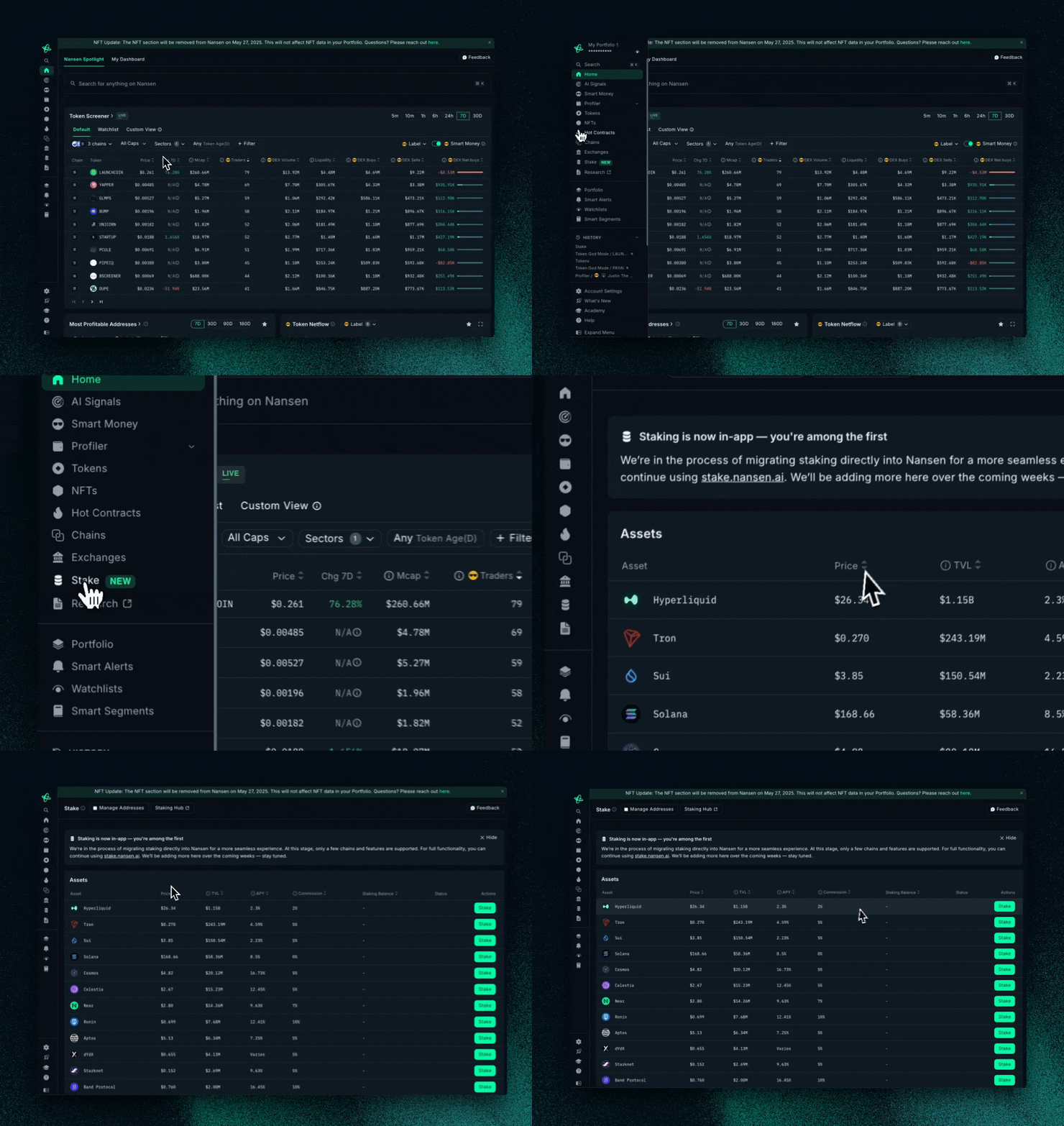
Depending on if you’re staking in-app or off-app (externally):
If in-app, simple hit the stake button for your given chain
If off-app, select the Nansen validator when managing your stake
💡 Learn about Nansen Staking 101
What is the APY shown based on?
The Annual Percentage Yield (APY) shown for Staking is an annualized rate.
It is computed after subtracting staking fees.
Every staking network has a different inflation rate and staked ratio, which directly impacts the APY.
The APY varies depending on the project. Some are not compounded automatically - users have to claim rewards and re-stake the crypto assets to compound rewards.
Why does the APY fluctuate? The APY on each staking network is impacted by the following.
Inflation rate: usually trends towards a lower bound or upper bound depending on the staked ratio.
Staked ratio: the number of tokens staked vs. the total amount of tokens for the protocol.
Transaction fees: the amount of fees paid to the protocol when transactions take place. It is distributed pro-rata to all stakers.
What are the risks involved with staking? The main 2 types of risks associated with staking are:
Validator uptime risk: Stakes will be slashed by a small % (usually 0.01%) if your chosen validator misses more than X% of Y blocks. Every protocol is slightly different. For example, Cosmos requires validators to sign 95% of any consecutive 10,000 blocks.
Malicious action by validator: For example, double signing a block, will result in a large % slash (usually 5%) on all stakes with the malicious validator. This is why it is important to pick a time-tested, trustworthy validator such as Nansen.
What is bonding and unbonding?
Bonding is the process of locking up digital assets to stake to a validator node in a Proof-of-Stake (PoS) network. Once bonded, these tokens contribute to network security and cannot be freely transferred until they are unbonded.
Unbonding is a process that often includes a cooldown period before funds can be withdrawn or become liquid. In most networks, bonded tokens earn rewards at the same rate as other delegated stakes on the validator, ensuring that node operators are incentivized to participate honestly and effectively.
Why is there an unbonding period to unstake my assets?
Certain protocols impose a lock-up period after assets are unbonded to prevent long-range attacks. During the unbonding period, you do not earn rewards on your assets and will still remain susceptible to slashing risks.
Depending on the network parameter, unbonding period ranges from 1 day to 30 days.
Which chains have a bonding period?
The following chains on Nansen have bonding periods:
Hyperliquid - 24 hours (1 epoch)
SUI - 24 hours (1 epoch)
Solana - 2-3days (1 epoch)
Is there any insurance cover for Staking on Nansen?
We have a 100% SLA on uptime slashing and loss of rewards due to validator downtime. We do not provide insurance for double signing.
What are the fees involved?
Nansen charges different fees for each staking network due to the amount of resources required to maintain the node. The fees charged are shown on each individual protocol's documentation page.
What if I can’t see an asset I staked in the portal?
As part of an ongoing effort to improve the staking experience, Nansen may sunset validator support for an under utilised network. This helps us concentrate resources where they matter most and deliver a smoother, more reliable staking experience.
You can view the full list of deprecated chains here.
What chains are available on Nansen?
Please visit this Chain Availability article to get a list of all active and deprecated chains.
Why can't I connect my staking wallet to my account? It says it's already linked to another email.
Each wallet can only be linked to one account at a time to maintain Points system integrity and prevent exploitation.
To resolve this, here are your options:
Option 1: Sign in using the original email connected to your wallet to access your existing account and Points.
Option 2: If you want to move your wallet to a different account, our support team can help by
Disconnecting the wallet from the current account (only possible if no rewards have been redeemed)
Allowing you to reconnect it to your preferred account
If you need assistance here, we’re happy to help. Contact our support team—they can help you disconnect wallets when appropriate and guide you through the reconnection process.
Important Note: Once Points rewards have been redeemed, wallet connections cannot be changed.